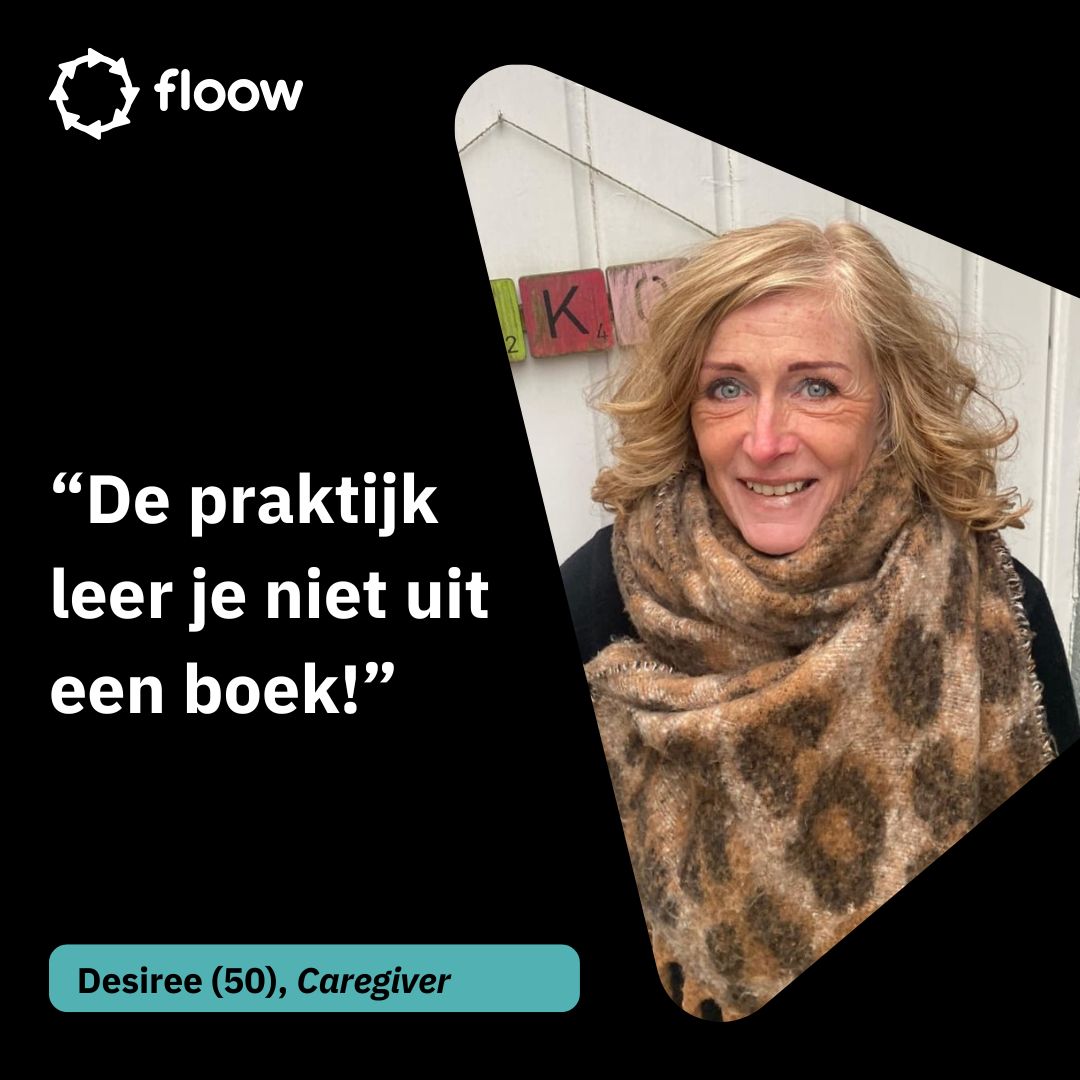
At Floow.ai we think it's important to make real stories from care visible. This time the spotlight is on Desiree (50). She shows how broadly you can develop within the sector: she once started in a nursery, switched to disability care, and now brings her experience to elderly care as a caregiver at Dovida. An experienced professional who knows care inside out.
You've worked in childcare, disability care and now elderly care. What drives you to keep taking on a new challenge?
“I simply love progress and development; new challenges are really my thing. I always want to keep learning. I moved from the nursery to disability care because I could get a permanent contract with more hours there. At some point I got a bit stuck in intellectual-disability care. After working in various homes, I saw a new challenge: in Alkmaar a nursing home started small-scale living for people with memory problems. After a year I got the chance to train as a Verzorgende IG. Every new place brings fresh energy and new lessons.”
You also started a nursing course at one point, but it went differently than planned. What happened?
“I stranded after nine months because the theory at school didn't match my practice on the work floor at all. I worked in a group with clients with complex behaviour, while the course focused on nursing-technical procedures like IV drips. Because I never encountered those in practice, I couldn't absorb the theory. I'm really a practical person; I have to do it and experience it to learn it.”
Today you work as a caregiver at Dovida. What surprised you most in this switch?
“I think it's wonderful that here I really have time for the clients; I'm with someone for at least an hour. It's work where you make a direct difference in others' lives every day. Thanks to this support, people can keep living longer in their own, familiar environment.”
What do you often still see going wrong when onboarding new colleagues?
“It starts with a warm welcome. Sometimes a trainee arrives on her first day and the team doesn't even know she's coming. That feels unsafe. Onboarding days are also often cancelled due to staff shortages or illness. My advice to employers: look at the individual. One person needs four days, another needs eight. Ask where their needs lie instead of just following the rules. A good start, where you're warmly received, is half the work.”
Can you give an example of what makes your work in care so beautiful?
“I visit a couple whose husband (94) has dementia. His wife is his carer 24/7, which is very intensive for her. With the right approach we managed to bring him to day care one afternoon a week. This gives his wife, who is herself over 90, some time for herself. It's wonderful to achieve this and see what it means for both of them. I also visit a lady for whom I cook and with whom I eat together. I offer her a listening ear and she's always so grateful and complimentary. Being truly there for the client makes my work special; every day is different. The lovely reactions from clients, partners or family are the real 'raisins in the porridge' for me.”
What would you say to people hesitating to take the step into care?
“Dare to step in with a blank slate. Start small-scale if a big ward puts you off. Care is wonderful if you're willing to work with your heart. You get back so much gratitude, not only from clients but also from their families whom you relieve. It's the most beautiful profession there is.”
We warmly thank Desiree for her openness and inspiration. Her story shows how valuable working in care can be — for yourself and for the people you help along the way.